01785 254 597

Precision Controlled Dosing
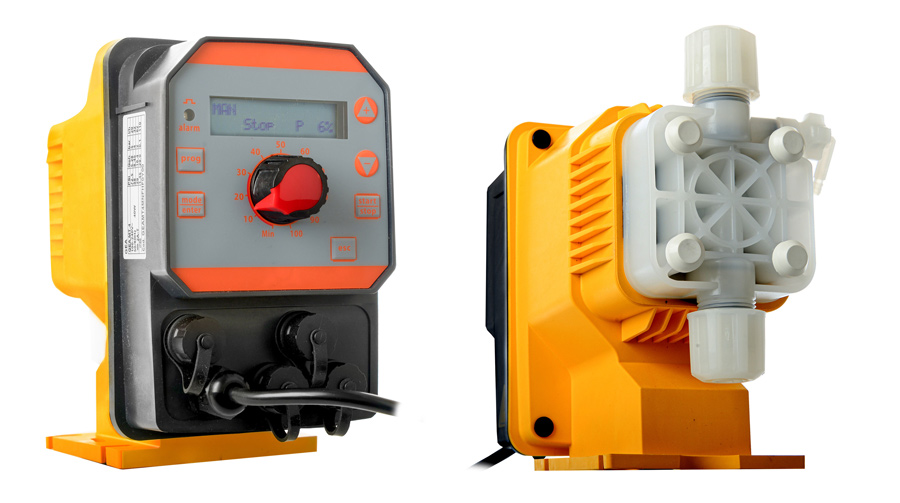
Our RDP range of electronic dosing pumps provides a reliable and versatile solution for accurate chemical dosing across a wide range of industrial applications. The range includes both surface- and foot-mounted pumps, with the flagship GEA-R-MT series offering advanced microprocessor-based control and a range of flexible operating options.
Available in four models, GEA1 to GEA4, the GEA-R-MT range offers a choice of flow rates and discharge pressures to suit different dosing requirements. Capacities range from 2.5 litres/hour against 20 bar on the GEA1-R-MT-20-2.5, through to 30 litres/hour on the GEA4-R-MT-60-1.0, with models capable of operating at pressures up to 20 bar. This range of options allows the pump to be selected to match both the required chemical dosing rate and process pressure.
The pumps feature PVDF pump heads, PTFE diaphragms, ceramic ball valves, and Viton or EPDM seals and O-rings. These materials make the GEA-R-MT suitable for most commonly used industrial chemicals. Alternative materials are also available for selected pump and valve components where greater chemical resistance is required. Strong acids and mixtures of strong acids may require specific compatibility checks before use, and we can advise on suitable materials for more demanding applications.
The GEA-R-MT provides flexible control, allowing the pump speed or stroke rate to be adjusted manually using the up and down controls, or automatically via a 4–20 mA signal, PFM (pulse frequency modulation), or volt-free contact closure, known as external pacing. Incoming pulses can be multiplied or divided to achieve the required dosing rate, with operation up to 300 strokes per minute. This provides the flexibility to integrate the pump into a wide range of existing control systems.
This makes the GEA-R-MT particularly suitable for flow-proportional dosing and automated process control. External pacing signals can be provided by contacting-head water meters or magnetic flow meters, allowing the chemical dosing rate to follow changes in water flow. The pumps can also be controlled for pH correction when used with our P6587 or P7687 pH controllers.
Each pump is supplied with a foot valve incorporating a filter and non-return valve to help maintain pump prime when changing chemical containers or when the pump is not operating for extended periods. An injection valve with an integral non-return valve is also supplied for dosing into pressurised pipework, helping prevent process fluid from entering the dosing line.
To complete the installation, LDPE polyethylene dosing hose is available for the discharge connection, along with soft PVC suction tubing for connection between the pump and foot valve. Together with the range of pump configurations and control options, this provides a complete and adaptable dosing solution for industrial chemical and water treatment applications.
Top 13 Dosing Tips
1. Ensure the chemical being pumped is clean and free from foreign bodies or debris.
2. Always fit the foot valve/strainer assembly and injection fitting supplied with the pump.
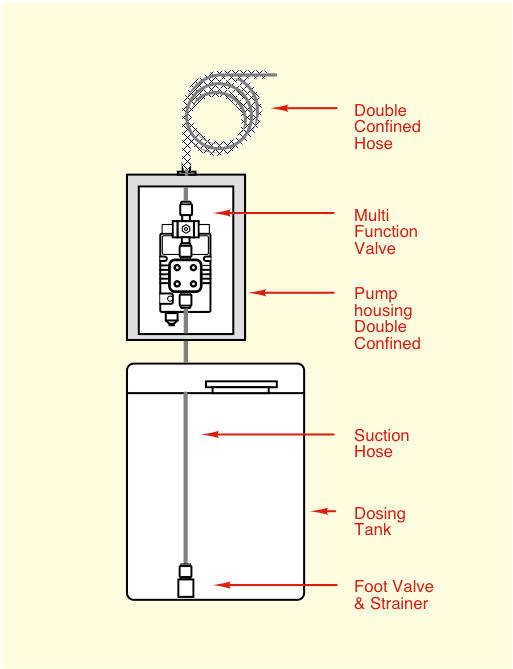
3. Keep the suction hose as short as possible; less than 1200 mm is recommended.
4. Keep the suction hose vertical to prevent air locks from forming.
5. If pumping downhill, i.e. where the suction point is higher than the discharge point, or into a lower-pressure point such as a pump suction (not recommended), fit an anti-siphon or loading valve to prevent siphoning.
6. Install the dosing hose inside a secondary hose to provide double confinement.
7. Always ensure the wetted parts of the pump are compatible with the chemical reagent being dosed. If in doubt, refer to our online chemical compatibility chart.
8. Always install duty and standby pumps where uninterrupted dosing is required.
9. Always keep adequate spare parts in stock at the site where the pump is installed.
10. Fit a local electrical isolator to the dosing pump supply.
11. Do not operate a pump that is leaking chemical reagent. Replace the seal and O-ring as soon as a leak is identified.
12. Always fit a dosing pump handling hazardous reagents inside a suitable housing to provide double confinement.
13. Do not mount pumps above equipment or items that could be damaged by an ingress of liquid.
HY Pumps
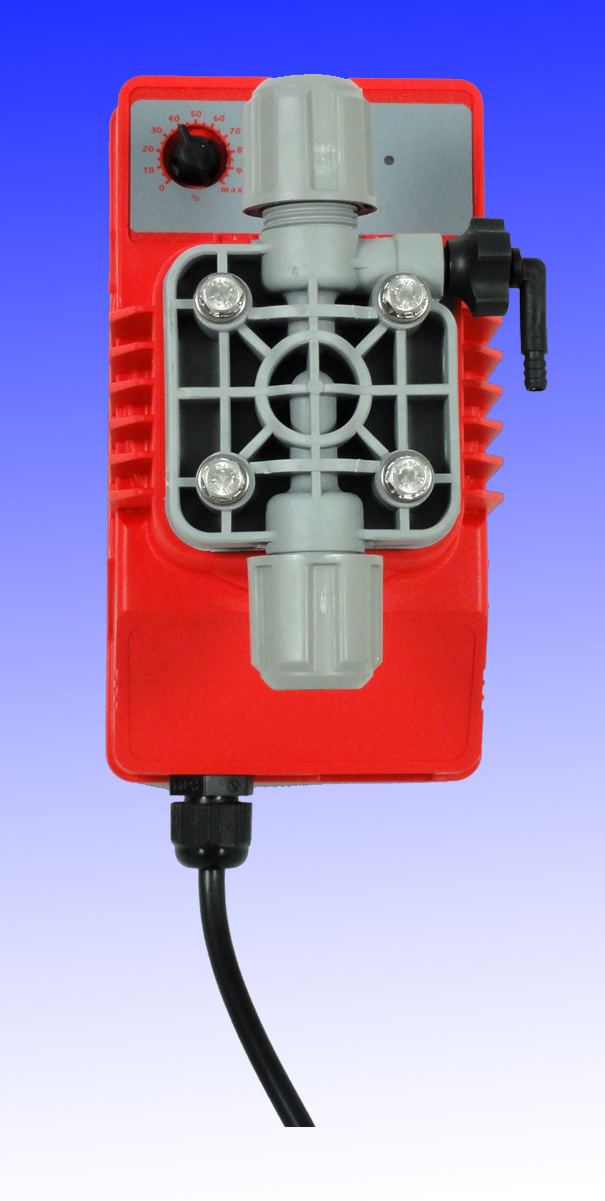
We provide a wide variety of small-dosing pumps to different industries so that they can dose chemical reagents into their own processes. The only thing that all of these pumps have in common is that it is absolutely necessary for our customers for the pumps to continue to dose the required chemical reagents reliably and consistently. Our remake kits are generally kept in stock.
The components needed to reassemble the wetted part of the pump are all included in our remake kits. They typically consist of the pump head together with new "O" seals, a diaphragm that, in the majority of cases, is made of solid PTFE and has a mounting thread, as well as the suction and delivery valves complete with their "O" seals and hose connection fittings. The kits also contain a new set of stainless-steel mounting bolts, washers and bolt caps.
With our Red Series electronic dosing pumps the pump heads are generally made from PVDF since this material offers good resistance to most of the chemical reagents being pumped. If you are getting a remake kit you must state the required 'O' ring material, that is to say whether it is Viton or EPDM, to make sure that it is compatible with the chemical reagent being dosed. When you have reassembled the liquid end of the pump, make sure that the mounting bolts are still tight after a few hours of operation; this will help to prevent leaks occurring as the parts settle during the initial running.
It would be advisable to buy a remake kit at the same time as the pump and keep it nearby in case it is needed. Even better, if continuous operation is essential, then fit both a duty pump and a standby pump so that the standby pump can be put into use while the duty pump is being maintained or rebuilt.
That concludes the Spring 2026 Watermark, You can also download the Watermark as a PDF here